Stretch Goal #1 Reached!
26 days ago
– Wed, Sep 23, 2026 at 10:46:17 AM
We did it! Our first stretch goal achieved!
Thank you to the backers who helped push the project this far 💜
Next up on the stretch goal list is a second bookmark design. In a previous update I said the variant would be the second-place winner from the poll, but what do you think? Maybe there's a mimic that wasn't listed as an option that you'd like to see?

Bookmark Design Poll results!
28 days ago
– Mon, Sep 21, 2026 at 12:18:57 PM
Here's the winning design for the bookmark, the Dragon Flower Mantis!
Thank you to everyone who voted💜

If you're interested in seeing the process of the mantis being drawn,
click here for the real-time video!
When we hit the second stretch goal, I'll turn the second-place design (Peruvian Shield Mantis) into a bookmark as well.
Sticker Sheet Reveal!
about 1 month ago
– Thu, Sep 17, 2026 at 02:13:05 PM
Time for the unveiling of the sticker sheet! Available to Masters of Disguise, Amazing Mimics, Sticker Mimics, and as an add-on for other tiers!

This is a 4"x6" sticker sheet featuring mimics that I couldn't fit into the book. Here's some details on these amazing animals:
- Termite-mimicking Rove Beetle (Austrospirachtha carrijoi): A beetle that lives parasitically inside termite nests. To blend in, it not only smells like a termite but has an overgrown abdomen shaped like a termite's body!
- Cheetah Cub (Acinonyx jubatus): Young cheetahs have a poof of gray hair on their backs that make them look like honey badgers. Honey badgers are fearless predators, so most animals stay away from them.
- Cinereous Mourner Chick (Laniocera hypopyrra): These birds begin life with fluffy orange feathers that make them look like flannel moth caterpillars, who hide a painful sting beneath their long hairs. The chick even moves like a caterpillar to make the disguise more convincing.
- Pinnate Batfish Juvenile (Platax pinnatus): The stunning color and frilly fins makes the fish look like a poisonous flatworm swimming around. They lose this bright coloration when they become adults, instead traveling in schools for protection.
- Fungus-mimicking Orb Weaver (Taczanowskia waska): Recently discovered in Ecuador, this spider is unusual because it mimics a dead spider infected by a fungus! It captures unsuspecting insects that get too close.
- Buff-tip Moth (Phalera bucephala): A moth that mimics a freshly broken twig. When resting, the moth folds its wings to form a cylinder so that the pale spots on both ends look like splintered wood.
In other news, we're about $400 away from the first stretch goal!
Cover art update!
about 1 month ago
– Tue, Sep 15, 2026 at 11:54:33 AM
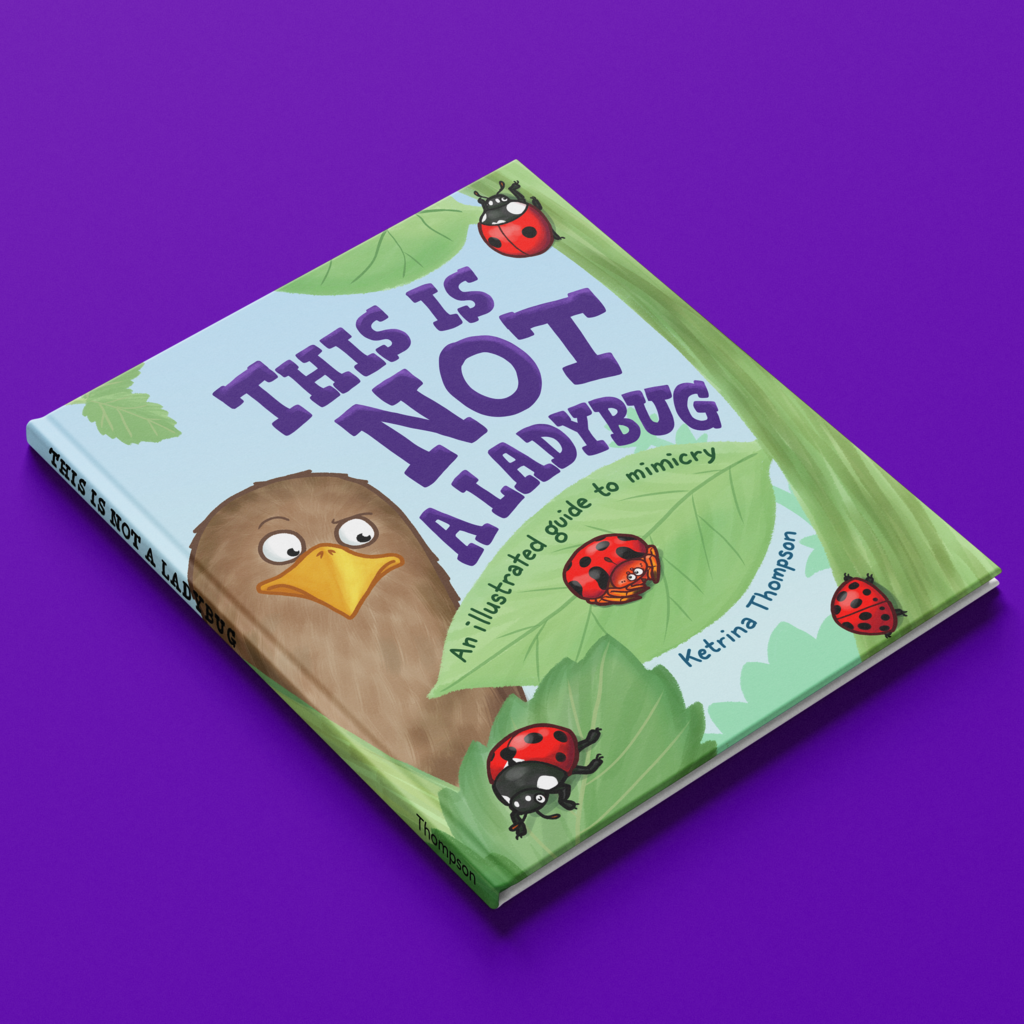
After staring at covers at a book fair, I felt inspired to finish up the cover! Look at all that hand-drawn text!
If we hit the 2K stretch goal, the cover will be elevated with some glossy spot UV!
Share this project with your fellow bug aficionados and let's get that upgrade!
Bookmark Design Poll!
about 1 month ago
– Mon, Sep 14, 2026 at 10:12:33 AM
Poll is up for choosing the design for the bookmark!
Here's some deets on the featured mimics!
- Peruvian Shield Mantis (Choeradodis rhombicollis): A mantis with leaf-like pronotum and wings. It pretends to be a leaf to ambush unsuspecting insects!
- Northern Pygmy Owl (Glaucidium californicum): A small owl with eyespots on the back of its head. The fake eyes fool predators into thinking that the owl is staring right at them, preventing sneak attacks!
- Dragon Flower Mantis (Toxodera integrifolia): A stunningly-colored and strangely-shaped mantis. It mimics a long, tubular flower found in the tropical rainforests it inhabits!
- Eastern Coral Snake (Micrurus fulvius) & Scarlet Kingsnake (Lampropeltis elapsoides): The coral snake is the venomous model, and the kingsnake is the non-venomous mimic. Most animals don't want to find out the hard way which is which.
- Monarch Butterfly (Danaus plexippus) & Viceroy Butterfly (Limenitis archippus): Once considered a Batesian mimic of the monarch, more recent research discovered that birds also find viceroy butterflies distasteful. Now monarchs and viceroy butterflies are considered Müllerian mimics!
- Red Spotted Nudibranchs (Chromodoris species): Multiple species of chromodorid nudibranchs in Australia are Müllerian mimics of each other, all taking on a similar pattern of white with red spots as a warning of their toxicity.
First place becomes the bookmark design, but if we hit our stretch goal of $2500, the second place design will be available as an alternate option!